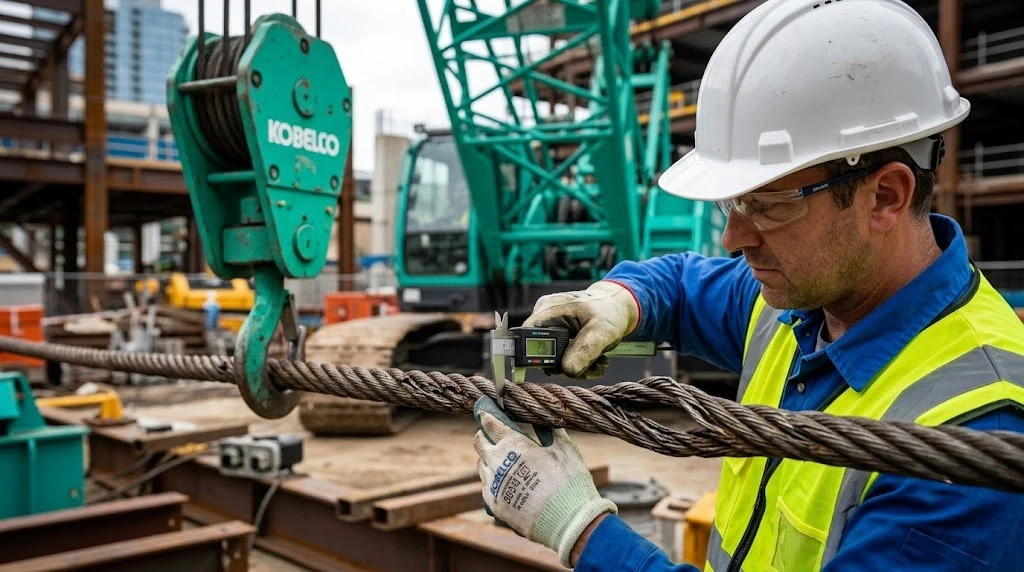
The hoist rope on any lifting machine carries the entire burden of every operation. For a Kobelco crane, this single component represents the final link between the operator’s controls and the suspended load. A failure in this line results in an uncontrolled drop, with all the associated dangers. Understanding the indicators of rope deterioration is not optional for those responsible for crane safety.
Wire rope undergoes continuous stress during normal operation. Bending, tension, and abrasion gradually degrade its structural integrity. Recognizing when these degradations have progressed beyond safe limits requires systematic inspection and knowledge of specific failure criteria. The following conditions should prompt immediate removal from service.
1. Fractured Outer Wires
This represents the most straightforward condition to identify visually. Each time the rope passes over a sheave, the outer strands experience bending stress. Repetitive flexing eventually causes individual wires to crack and separate. These fractured ends create sharp protrusions that can injure workers handling the line.
The location and quantity of breaks determine the urgency. A small number of fractures scattered along the rope may not be cause for alarm. However, inspectors must focus on one lay length, which is the distance required for a single strand to make a complete spiral. Finding six broken wires within that span means the rope must be condemned. Similarly, three breaks confined to one strand in the same lay length also mandate removal.
Attempts to continue using a rope with broken wires by trimming them or applying tape are unsafe practices. Every fracture reduces the effective load-bearing area. The rope’s capacity diminishes progressively, and eventual failure is certain.
2. Shrinkage in Diameter
Tension causes wire rope to elongate elastically and, over time, plastically. As stretching occurs, the internal core compresses and the overall cross-section diminishes. This reduction interferes with proper sheave engagement, causing the rope to ride too deep and accelerate groove wear.
Precise measurement with a caliper is essential. Eyeballing the diameter is not sufficiently accurate. Take readings on a straight, lightly tensioned segment away from termination points. If the measurement shows a reduction of 5 percent or more from the nominal size, the rope must be taken out of service.
For instance, a rope originally measuring 20 millimeters that now reads 19 millimeters has lost critical core support. That 5 percent threshold indicates the central structure has collapsed. The outer strands may look acceptable, but the internal foundation is compromised.
3. Oxidation and Rust Formation
Factory-applied lubricants serve a dual purpose. They shield the steel from moisture and reduce friction between moving strands during bending cycles. When this protection deteriorates, corrosion begins. Surface rust may appear harmless, but internal oxidation is far more dangerous.
Evidence of internal corrosion includes reddish-brown dust or residue escaping from the rope as it flexes. A rope that feels stiff and dry, accompanied by a grinding noise during sheave passage, likely suffers from advanced internal rust. Pitting from corrosion creates stress concentration points where cracks initiate.
Spray-on lubricants cannot reverse pitting damage. Once the steel surface shows corrosion-related pitting, the rope has lost its original strength characteristics. Replacement is the only appropriate response.
4. Structural Distortion
Wire rope is engineered to bend around sheaves and drums within specific radius parameters. It cannot tolerate sharp kinks, crushing loads, or permanent twisting. Any distortion alters the internal wire arrangement and creates weak points.
Birdcaging occurs when the outer strands separate and bulge outward following sudden load release. The core expands rapidly, pushing the strands apart. Crushed sections result from heavy objects compressing the rope. Kinks form when the rope is doubled over and then straightened.
These deformations prevent uniform load distribution across the rope’s cross-section. The distorted zone carries excessive stress and will fail prematurely. Attempting to reshape or straighten kinked rope only worsens the damage.
5. Exposure to High Temperatures
The steel in wire rope receives specific heat treatment during manufacturing to achieve desired strength properties. Subsequent exposure to high heat alters this microstructure and introduces brittleness. Even small, localized hot spots create vulnerable regions.
Welding activities pose the greatest threat on construction sites. Arc flashes or sparks can melt individual strands or fuse adjacent wires together. Burn marks, discoloration, or welding splatter adhered to the rope all indicate thermal exposure. The affected area becomes hardened and prone to sudden fracture without warning.
Frictional heating from rope slipping on the winch drum can also cause thermal degradation. Glazed surfaces and a hardened feel suggest the rope has been overheated. Any rope exhibiting signs of heat damage should be retired immediately.
6. Core Extrusion
The core provides the structural backbone for the outer strands. In certain failure scenarios, the core extrudes outward through the gaps between strands. Fiber cores appear as whitish filaments, while steel cores bulge visibly.
Shock loading and excessive twisting commonly trigger this condition. When the core protrudes, the outer strands lose their supporting structure. The rope’s geometry has fundamentally failed, and lifting capacity is severely degraded.
If core protrusion is noted, crane operations should cease at once. The outer strands will collapse inward under tension, leading to rapid failure. No repair is possible for this condition.
7. Flattening of Strand Crowns
The crowns represent the outermost contact points of the outer strands. These surfaces bear directly against sheave grooves and drum faces during normal operation. Gradual flattening is expected, but excessive wear reduces wire cross-section.
When crowns have worn flat and individual wire diameter is reduced by 40 percent or more, the rope’s strength is significantly compromised. A tactile check can reveal this condition, as worn rope feels smooth and polished rather than textured and irregular.
This wear pattern often concentrates in sections that pass over idle sheaves or through tight radius bends. Regular monitoring of crown condition helps identify ropes approaching the end of their service life.
Pre-Operation Inspection Protocol
Integrate wire rope examination into the daily startup procedure. Before making the initial lift, assess the entire working length. Focus attention on attachment points at the hook block and segments that traverse equalizer sheaves, as these areas frequently show accelerated deterioration.
When replacement is indicated, ensure the new rope matches the correct specification for your machine. Working with a supplier that understands Kobelco crane parts helps guarantee proper grade, diameter, and construction type. Reliable suppliers of crane spare parts can verify rope classifications and provide guidance on correct selection.
Maintaining adequate stock of Kobelco crane parts for hoist ropes minimizes downtime during replacement events. Similarly, a well-organized inventory of crane spare parts ensures that critical components are available when needed. Operators who prioritize genuine Kobelco crane parts and quality crane spare parts reduce risks associated with improper rope substitution.
Regular inspection and timely rope replacement represent fundamental safety practices. The investment in a new rope is modest compared to the potential losses from a dropped load. When warning signs appear, the prudent decision is to replace without delay.

Comments
No comments yet. Be the first to react!