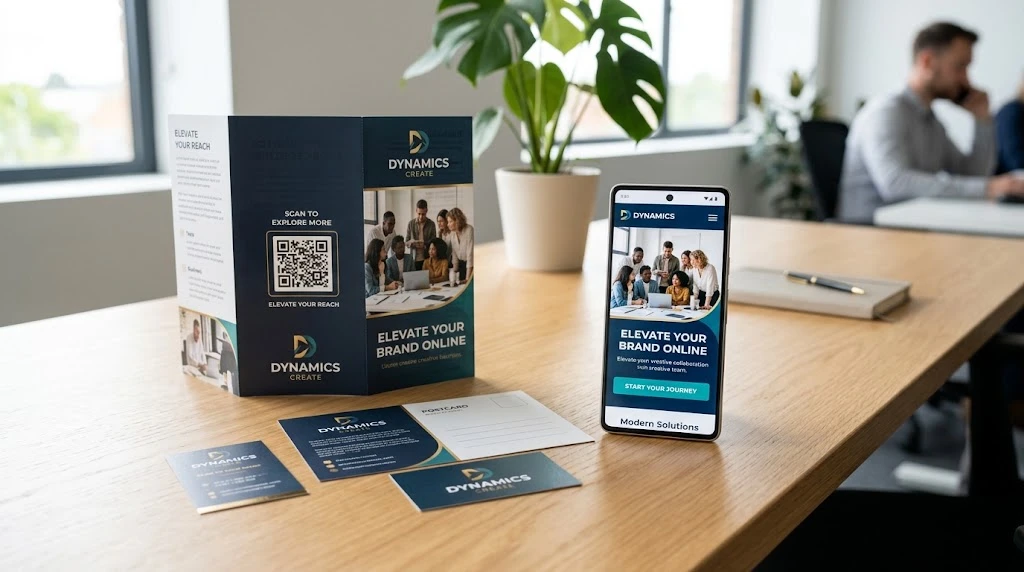
You have just sent 5,000 brochures to print. Weeks went into selecting the paper and refining the colors. But what happens when a reader decides to look your company up online?
Many businesses still treat print and web design as unrelated projects. The brochure follows one style, while the website follows another. This mismatch creates a jarring experience for the customer.
Your offline and online marketing should reinforce each other. When web design supports your print materials, you build trust and make purchasing easier for customers. Let’s explore how a website designer bridges this gap.
Match Your Visual Identity
Consider how a customer encounters your brand. They might notice your postcard in the mail, then search for your business on their phone. If the postcard uses sleek, modern typography but your website uses a cluttered, outdated font, they might question whether they found the right company.
Visual consistency connects print and digital. Your website needs to use the same color palette, typography, and logo treatment as your printed materials. This does not mean your website should look exactly like a printed page—screens and paper are different mediums. But the core brand elements must match.
A skilled web design company will ask for your brand guidelines before starting a project. They want to see your business cards, flyers, and brochures. They use these as a baseline so the transition from paper to screen feels natural.
Connect the Dots with Specific URLs
Moving someone from a printed page to a website takes effort. Nobody wants to type a long, complicated web address into their phone. You have to make the jump from offline to online as smooth as possible.
This starts with smart URLs. Instead of sending people to “yourcompany.com/products/category/item123,” use a simple, memorable link. Something like “yourcompany.com/autumn” works much better on a flyer.
QR codes are also making a massive comeback. Placing a QR code on a direct mail piece or a poster allows people to skip the typing entirely. But scanning the code is just the first step. The page they land on needs to deliver what the print ad promised.
Your website designer can set up these specific redirect links and ensure the QR codes point to the right places. They test the process on different devices to make sure the journey from paper to screen never hits a dead end.
Build Dedicated Landing Pages
Never send print traffic to a standard homepage. A homepage is a general front door. It has to greet everyone, from investors to job seekers. When someone takes the time to respond to your print ad, they deserve a specific destination.
If your brochure advertises a spring sale, the QR code should link to a landing page dedicated entirely to that sale. The page should show the exact products featured in the brochure and offer the same discount. This continuity reassures the customer that they are in the right spot.
Dedicated landing pages also help you measure success. Print marketing is notoriously hard to track. You never really know how many people read a magazine ad. But if you create a unique URL for that ad, you can track exactly how many people visited the page and how long they stayed. This data proves whether your print campaign actually worked.
A good web design company will often plan these landing pages as part of your overall strategy. They design templates that match your print layout, making it easy to launch a new page whenever you run a new offline campaign.
Make Mobile a Priority
When someone holds a piece of print marketing, they usually have their phone nearby. If they scan a QR code from a flyer, they are looking at your website on a mobile screen. If your site is not optimized for mobile, your print marketing just failed.
Mobile design is not just shrinking a desktop site to fit a smaller screen. It involves creating a touch-friendly experience. Buttons need to be large enough to tap. Text needs to be readable without zooming. Menus need to collapse neatly.
A website designer knows how to structure content for mobile users who are on the go. They understand that mobile users want quick answers. They want to know your hours, your location, and how to contact you. If your print ad hooked them, your mobile site needs to reel them in.
Sync Offline and Online Contact Details
Consistency goes beyond colors and fonts. It includes your actual business information. If your brochure says your store opens at 9 AM, your website better say the same thing.
Mismatched contact details confuse customers and hurt your local search rankings. Search engines like Google cross-reference the information on your website with data from other sources. If your print materials list an old address, and your website lists a new one, search engines get confused.
Work with your web design company to ensure your website prominently displays your correct name, address, and phone number. Embed a live map on your contact page. When a customer reads about your location in a printed ad, they should be able to verify it instantly online.
Let Print Drive Action and Web Deliver Value
Print marketing is excellent at grabbing attention. A well-designed postcard stands out in a pile of boring mail. A billboard catches your eye on the highway. But print has limits. You can only fit so much information on a single page.
This is where web design picks up the slack. Use your print materials to spark curiosity. Give them a reason to visit your site. Then, use your website to deliver the deep dive. Once they arrive, the website can show video demonstrations, customer reviews, and detailed product specifications.
Your website designer can structure your site to guide these visitors toward a purchase. They can place clear calls-to-action right where the user expects them. The print piece gets the foot in the door, and the website closes the deal.
Wrapping Up
Treating your website and print marketing as separate silos leaves money on the table. Customers do not see channels; they see your brand. They expect a seamless transition whether they are holding a brochure or tapping a screen.
When you bring your offline and online strategies together, everything works harder. Your print ads get better response rates because they point to clear, helpful web pages. Your website gets more traffic because your printed materials give people a reason to visit.
If you are planning a print campaign, bring your web design company into the conversation early. A good website designer will look at the whole picture. They will make sure your digital presence actively supports the ink and paper you invest in, turning a simple ad into a complete customer experience.

Comments
No comments yet. Be the first to react!