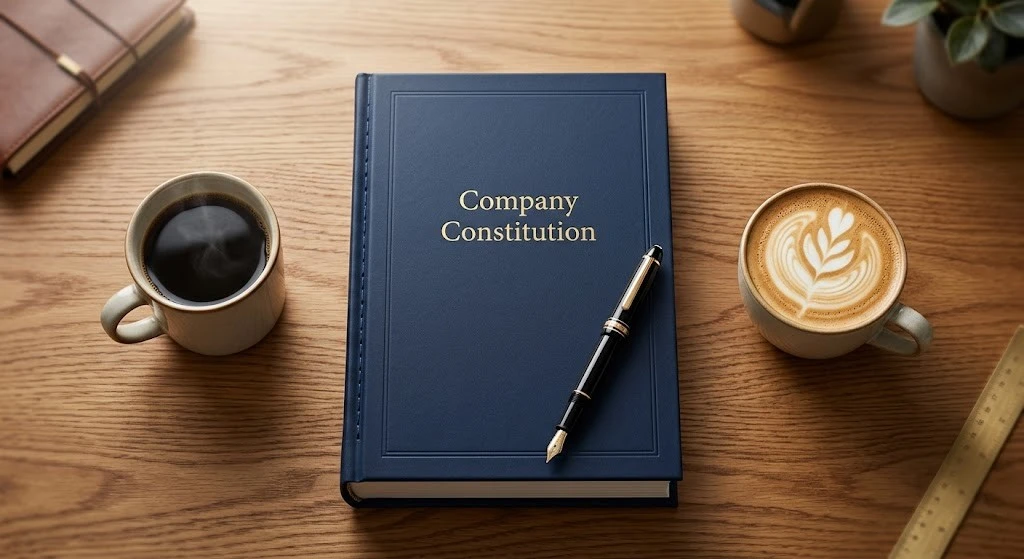
Imagine starting a venture with a trusted partner. Excitement carries you through the early days. Then suddenly, one of you wants to sell their shares to an outsider, or you cannot see eye to eye on a major expense. Who gets to decide the outcome? That answer should already be recorded in your company constitution.
In Singapore, this governing document was previously called the Memorandum and Articles of Association (M&AA). Today, it is known simply as the Company Constitution. View it as your business’s internal rulebook—it governs how your company operates, makes decisions, and handles disputes.
The Companies Act supplies the default legal framework for all companies. Your constitution acts as a customised set of rules that sits directly beneath that law. Where the Act mandates a specific requirement, your constitution cannot override it. But for all other matters, the constitution sets the unique rules for your business, defining the relationships between the company, its directors, and its shareholders.
What to Consider When Drafting
When you draft a constitution, you are essentially anticipating future problems. A well-prepared document answers difficult questions before they escalate into arguments. You want to cover the scenarios that commonly generate friction as the business matures.
For instance, what rules apply to share transfers? Can a founder sell their stake to any stranger, or do existing shareholders get the right of first refusal? How are directors appointed or removed from office? What happens to a shareholder’s equity if they pass away or leave the company?
You should also spell out dividend policies. The constitution can outline how and when profits are distributed, preventing resentment once the company starts making money. For businesses with multiple founders, including a deadlock resolution mechanism is highly sensible. This provides a clear path forward when the board is split evenly and cannot agree on a critical decision. A professional company secretary can help you identify which clauses are essential for preventing future disputes.
The Pitfalls of Relying on the Model Constitution
When you incorporate, ACRA provides a Model Constitution. For a single-director, single-shareholder company, this default template is often perfectly acceptable. It saves time and keeps setup costs low.
However, if you have multiple founders or outside investors, relying on the default model is a genuine risk. The generic rules are designed to fit everyone, which means they fit no one perfectly. They may not reflect your actual business agreement or your long-term vision. Customising this document during the setup phase is one of the smartest things you can do. It aligns your legal framework with your commercial reality. Engaging reliable corporate secretarial services at this stage ensures that your customisations are both legally sound and practically useful.
How to Properly Amend Your Constitution
A constitution is not set in stone. As your business grows, your needs will change. You might need to create new share classes to attract investors, or you might need to change how board meetings are called.
Amending the document follows a formal process. It cannot be changed by a single director on a whim. The process starts with the board of directors proposing the specific changes. Next, the shareholders must approve those changes. This requires a Special Resolution. In practical terms, this means at least 75 percent of the votes cast at a general meeting must be in favour of the amendment. You must give shareholders proper notice of the meeting and clearly state the proposed changes in the agenda.
Once the shareholders approve the changes, the work is not quite done. You must file the updated constitution with ACRA within 14 days. The amendment only takes legal effect once this filing is complete. Skipping this step leaves your company out of compliance, even if everyone internally agreed to the new rules. A knowledgeable company secretary will ensure that this filing is completed accurately and on time.
It is also worth noting that if you have a separate Shareholders’ Agreement, you must ensure the constitution amendment does not contradict it. Often, both documents need to be updated simultaneously to keep your legal framework consistent.
The Critical Role of Professional Support
This is where a qualified company secretary becomes invaluable. They do not just file paperwork. They understand the legal nuances of what you are trying to achieve. When you need to draft a custom constitution, a good secretary can flag clauses that might accidentally conflict with the Companies Act. When it is time to amend the document, they ensure the special resolution is drafted correctly, the meeting is convened properly, and the filing is submitted on time.
Relying on professional corporate secretarial Singapore means you have a built-in safety net. They keep track of these critical deadlines and ensure your internal rules always match your public filings. They act as a bridge between your commercial goals and regulatory compliance. This is not about outsourcing busywork. It is about risk management. A mistake in your foundational documents can invalidate board decisions or complicate future funding rounds. Many successful businesses maintain ongoing corporate secretarial services precisely to avoid such governance failures.
Common Mistakes to Avoid
Founders often make the mistake of treating the constitution as a one-time setup task. They file it and forget it. Years later, during a funding round or a dispute, they realise the document is outdated or missing crucial protections.
Another common error is having an oral agreement between founders that contradicts the written constitution. In the eyes of the law, the written document wins. If you agree to something different over coffee, get it formally amended in writing.
Finally, do not assume that amending the constitution automatically updates your ACRA profile. The filing step is mandatory. Late filings attract penalties, and a history of late filings can raise red flags during due diligence. A diligent company secretary will help you avoid these mistakes before they cause harm.
The Bottom Line
Your company constitution is the foundation of your corporate governance. It does not need to be a hundred pages of dense legal jargon. It just needs to be clear, practical, and tailored to your specific situation.
Take the time to get it right at the start. Talk through the hard scenarios with your co-founders and put the agreements in writing. And when your business evolves, do not hesitate to update it. A clear rulebook keeps everyone on the same page and lets you focus on what actually matters: growing the business.

Comments
No comments yet. Be the first to react!