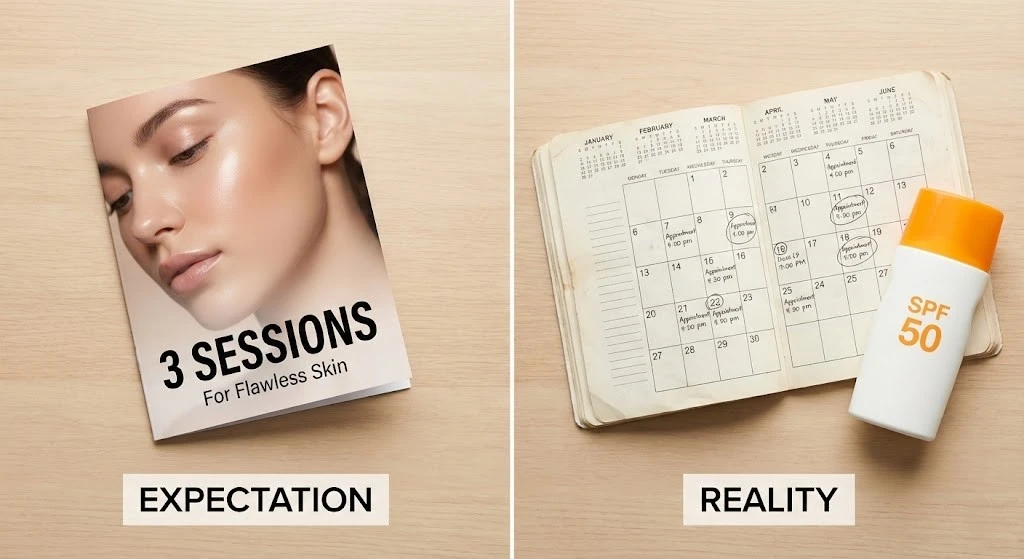
The marketing galleries are stunning. Complexions transformed in mere weeks. Pigmentation disorders that resisted everything finally cleared. Textural damage that appeared permanent now smooth and refined. Walk into any aesthetic clinic and the promotional displays make Pico laser treatment appear as the definitive modern solution for compromised skin. The technology isn’t imaginary—it represents verified medical advancement. But the conversation is strategically curated, excluding inconvenient complexities that might complicate your purchasing decision.
Here’s the disclosure that rarely accompanies the consultation.
The Mechanism Explained (No Commercial Enhancement)
Pico laser platforms operate by delivering energy pulses measured in picoseconds—one-trillionth of a second. This extraordinary rapidity creates a photoacoustic effect rather than pure thermal destruction. In practical application, pigment particles fragment through mechanical pressure waves instead of sustained heat exposure. This distinction matters profoundly because thermal damage historically caused post-inflammatory hyperpigmentation, the devastating complication that limited older nanosecond laser safety for melanin-rich populations.
Scientific validation exists. Peer-reviewed research documents Pico laser treatment effectiveness for tattoo elimination, melasma management, solar lentigines, and selected acne scarring patterns. However, “effectiveness” encompasses wide clinical variation, a range that marketing departments tend to present uniformly toward the favorable extreme.
Timeline Expectations: Where Sales Meets Cell Biology
The aesthetic clinic script is remarkably uniform: “three to five sessions and you’ll see dramatic results.” Occasionally accurate for simple, superficial concerns on pale skin. Melasma operates by entirely different biological rules. This multifactorial condition involving hormonal, genetic, and UV components doesn’t resolve in convenient quarterly packages. Three treatments often represents opening moves, not endgame.
A rigorous 2020 meta-analysis in the Journal of the American Academy of Dermatology confirmed that melasma recurrence persists at troubling rates regardless of laser sophistication. The fundamental limitation: lasers destroy pigment already present without touching the biological machinery producing it.
Skip your SPF 50 for a single afternoon, ignore your hormonal triggers, and the pigmentation returns. Maintenance becomes permanent—a predictable trajectory rarely priced into initial quotes.
For acne scarring, genuine improvement requires extended commitment. Clinically significant texture change typically emerges after four to eight sessions, spaced four to six weeks apart. That’s six to twelve months of treatment, not a quick seasonal fix. Recalculate costs across realistic timeframes, and the financial picture changes considerably.
Skin Tone Diversity: The Complexity That Disappears in Universal Claims
Pico laser technology is aggressively marketed as “safe for every skin type.”
Compared to ablative CO2 lasers, this holds relative truth. But safety operates on spectrum, not as binary condition. Fitzpatrick types IV through VI (rich brown through deep ebony skin) retain genuine PIH vulnerability when energy settings are miscalibrated or operators lack melanin-specific expertise.
The critical variable is the human holding the handpiece, not the brand on the device. Pico laser treatment performed by clinicians with deep experience across diverse phototypes, individually calibrating fluence and wavelength, produces beautiful outcomes. Identical equipment in inexperienced hands creates complications including blistering and permanent hypopigmentation. The certificate on the wall means little without knowing the operator’s specific training history.
During your aesthetic clinic consultation, demand specifics: How many patients with your exact skin depth have they personally treated? Can they demonstrate photographic evidence? If they hedge or appear uncomfortable, you’ve gathered valuable intelligence about their actual experience level.
Recovery: Personal Reality Versus Promotional Promise
“Minimal downtime” is the industry standard. Compared to aggressive resurfacing, this contains validity. But minimal isn’t none, and there’s wild variation between individuals and sessions.
Most experience flushing lasting several hours to a full day. Some get pinpoint bleeding or fine crusting for three to five days. Eye-area swelling can be surprisingly dramatic. And here’s what nobody tells first-timers: you don’t know your own reaction pattern yet. Scheduling important life events within forty-eight hours of initial Pico laser treatment is a gamble that aesthetic clinic staff routinely understate.
The post-treatment vigilance period gets even less airtime. For two to four weeks after each session, your skin is photosensitive at levels you’ve never experienced. One sunscreen failure during this window—one afternoon of forgetfulness—and you’ve funded your own pigmentation problem. That responsibility is yours alone, but its weight isn’t always clearly transferred.
What the Machine Actually Signifies
Pico laser isn’t a generic category. Major players include Picosure (Cynosure), Enlighten (Cutera), PicoWay (Candela), and Discovery PICO (Quanta). They differ in wavelength options, pulse durations, spot sizes, and specialized handpieces.
When an aesthetic clinic says they have “the latest Pico laser,” they’ve said almost nothing. What matters is whether their device has the right wavelength for your specific issue. The 1064nm wavelength goes deep for dermal pigmentation; 532nm hits superficial red and brown spots. Some machines have fractional lenses for texture work; others don’t. These distinctions determine your outcome, yet clinics present their device as all-capable without explaining the engineering specifics.
The “Actually, Not You” List (Buried in the Fine Print)
Pico laser treatment is contraindicated for pregnant patients, anyone on isotretinoin (or who recently finished), people with active skin infections or cold sores in the treatment zone, and certain autoimmune skin conditions. Recent tanning also precludes treatment, making summer scheduling in sunny climates logistically challenging.
Photosensitizing drugs—including some antibiotics, blood pressure medications, and even certain supplements—must be disclosed. A responsible aesthetic clinic asks comprehensively about your medical history and medications before scheduling. If they don’t, that’s a process gap worth noting.
The Honest Verdict
Pico laser is a real, well-studied therapeutic tool. For the right person, treated by skilled hands, it achieves what was impossible ten years ago. The technology genuinely moves dermatology forward for pigmentation and texture concerns.
But it’s management, not magic. It requires maintenance, sun discipline, patience with timelines, and a clinician who truly knows your skin. The aesthetic clinic that tells you all of this upfront—including that you might need more sessions than initially expected—is treating you with respect. The one leading with the three-session guarantee and the wall of dramatic transformations is optimizing for their revenue, not your outcome.
Go in prepared. Know that results accumulate, sometimes more slowly than the pitch suggests. Ask about the operator’s specific experience, not just the machine’s brand. And if you’re promised perfection in a fixed number of sessions with no caveats, bring skepticism.
The laser works. The conversation around it needs work.

Comments
No comments yet. Be the first to react!