Company closure is an inevitable part of the business landscape. Not every enterprise achieves lasting success. Some founders accomplish their initial objectives and choose to exit gracefully. Others face market disruptions that make continuation unviable.
In Singapore, the appropriate closure route depends entirely on the financial condition of your company. A business with no outstanding obligations and insignificant assets can be dissolved through a streamlined administrative process. A business with valuable holdings or unpaid creditor claims must undergo a formal statutory procedure.
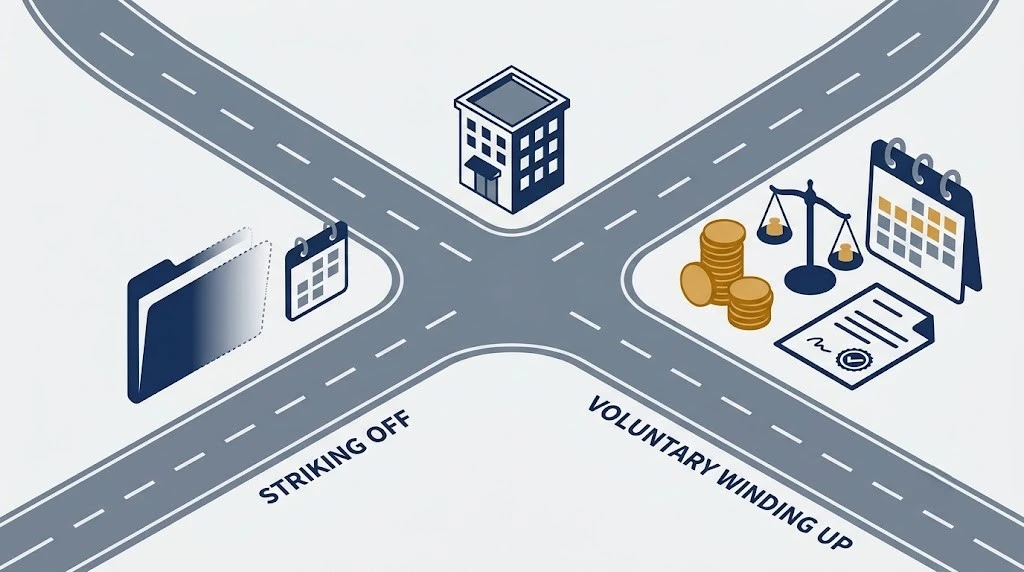
Two main options exist for dissolving a registered entity: striking off and voluntary winding up. Each is suited to different circumstances. The following sections provide a comprehensive overview of both processes.
Striking Off as an Option
Striking off is the administrative mechanism for closing a company that has ceased operations. It represents the most time-efficient and budget-friendly approach. You are essentially petitioning ACRA to remove your company’s name from the official register because the entity is no longer conducting business.
You file your application with the Accounting and Corporate Regulatory Authority (ACRA). When the authority grants approval, the company ceases to exist as a legal entity.
Qualification requires meeting several conditions. Your company must be dormant. You must have no unresolved tax liabilities with IRAS. The company must hold no remaining assets. There must be no unpaid debts and no pending legal proceedings. Additionally, the majority of your directors must consent to the striking-off application.
This route appeals to founders whose companies were incorporated but never began operating. It also suits businesses that have already liquidated inventory, closed bank accounts, and completed all operational wind-downs.
The filing procedure is uncomplicated. You submit the required documents to ACRA. Once approved, ACRA posts a notice in the Gazette. A one-month window allows creditors to object. If no objections arise, ACRA issues a final notice, and dissolution is complete. This typically takes three to five months.
Voluntary Winding Up as an Alternative
Voluntary winding up is a formal legal dissolution. You resort to this when your company retains assets or liabilities. This is not merely administrative; it entails a full statutory liquidation.
This path requires appointing a licensed liquidator. The liquidator takes charge of the company. Their role includes collecting outstanding debts, selling company assets, and using the proceeds to repay creditors. Any surplus remaining after creditor settlements goes to shareholders.
This category includes two variations: members’ voluntary winding up and creditors’ voluntary winding up.
Members’ voluntary winding up applies to solvent companies. The business must be able to pay all debts within 12 months. Directors must sign a formal solvency declaration. This is frequently used when owners retire or when shareholders of a successful enterprise wish to distribute surplus capital.
Creditors’ voluntary winding up applies to insolvent companies. The business cannot meet its financial commitments. In such cases, creditors exercise significant influence. They select the liquidator, whose primary duty is maximising recoveries for those owed money.
Voluntary winding up requires considerably more time than striking off. The process often extends beyond one year. Costs are also higher, reflecting liquidator fees and legal expenses.
Making the Right Selection
Choosing between striking off and winding up comes down to a straightforward financial evaluation.
Begin with your assets. If your company owns real estate, holds substantial cash, or possesses intellectual property, striking off is not permitted. ACRA will decline your application. You must proceed with winding up, enabling a liquidator to realise those assets and distribute funds properly.
Next, consider your debts. Outstanding amounts to suppliers, banks, or landlords disqualify you from striking off. Winding up ensures creditors are paid according to legal requirements. Trying to strike off with hidden debts invites objections from creditors. They may even apply to court to restore the company later, leading to serious legal consequences.
Finally, review your tax position. Even with no assets and no debts, ACRA will not approve striking off if you have unfiled returns or unpaid taxes. You must resolve all IRAS matters beforehand.
Executing a Striking Off
If you meet all criteria, striking off is a straightforward exercise.
First, secure a board resolution. Directors must formally record their agreement to close.
Second, obtain clearance from IRAS. This confirms that no tax obligations remain outstanding.
Third, after receiving IRAS clearance, submit your striking-off application to ACRA. The authority reviews the submission. If everything is in order, they issue a notice to your registered address and publish a Gazette notification.
A one-month waiting period follows. Creditors have this final opportunity to raise objections. If no objections are lodged, ACRA publishes the final Gazette notice. The company is officially dissolved at that point.
Executing a Voluntary Winding Up
Voluntary winding up requires a more elaborate set of steps.
For a members’ winding up, directors must first sign a solvency declaration. This document must be filed with ACRA within five days.
Next, convene a general meeting of shareholders. The shareholders must pass a special resolution authorising the winding up and appointing a liquidator. You must publish a Gazette notice of this resolution within seven days.
The liquidator then assumes full managerial authority. They notify all relevant parties, take custody of assets, and begin settling debts. Directors lose all decision-making power once the liquidator is appointed.
Finally, the liquidator organises final meetings with shareholders and creditors. They submit a final return to ACRA. Upon filing, the company is formally dissolved.
The Value of Experienced Support
Incorrect closure procedures can create serious liabilities. Mistakes in documentation or omitted statutory steps can expose directors to personal liability and regulatory penalties.
This is why professional assistance is highly recommended. Every Singapore company must maintain a company secretary. When closure is being considered, your company secretary should be your primary contact.
They possess detailed knowledge of your corporate records. They can identify overdue annual returns or unresolved tax issues. They can advise immediately on whether striking off is viable or whether winding up is compulsory.
If you opt for striking off, your company secretary will handle the ACRA filings. They will coordinate with your accountant to obtain the IRAS clearance. They will prepare the board resolutions and verify all internal records are current before final submission.
If winding up is required, the process becomes more demanding. You will likely need external corporate secretarial services Singapore to manage the legal requirements. These professionals can assist with drafting solvency declarations, organising shareholder meetings, preparing special resolutions, and managing Gazette publications. They act as a central coordination point, ensuring smooth communication between directors, accountants, the liquidator, and regulatory authorities. Their involvement helps ensure every procedural step is completed correctly before the company closes.
Final Words
Closing a business is a normal commercial decision. It does not signify failure. The chosen method, however, has important implications.
If your company is dormant, has no assets, and has no debt, striking off is the best option. It is fast, affordable, and efficient.
If your company still owns assets or owes money, voluntary winding up is the only proper course. Though longer and more costly, it protects you from liability and ensures creditors are treated fairly.
Do not navigate this process alone. Engage professionals with expertise in corporate secretarial services. They will guide you through the regulatory requirements and help you fulfil every obligation. Closing your business correctly provides a clean foundation for your future endeavours.

Comments
No comments yet. Be the first to react!